
The existence of MESHOA came about almost by accident after a trip to visit family in Mozambique resulted in our chairman returning to South Africa having to expand on an idea to help the community create a community college through practical training of unemployed volunteers within the very remote and rural area of Chicumbane in Mozambique’s Gaza province. Yes, the same Gaza Donald Trump confused with Pallestine, whose genocide he supports actively.

While visiting family in Chicumbane, our chairman didn’t know that he was talking to one of the local municipal administrators who was interested in our chairman’s IT background and desire to help communities like theirs to have access to computer training and have access to the internet because it could help the unemployed members of the community change their own lives with access to the knowledge we all take for granted with our smartphones.
Having just moved back to South Africa after 5 years in Denmark, Viri, our chairman spoke about an idea of allowing unemployed members of the community to volunteer for practical training courses given by volunteer trainers who only need a place to stay when community service and teaching forms part of their further education. Having lived, studied and worked in Denmark, he met people with various skills and trades who would have loved the opportunity of providing those services in African countries.
Viri was asked not to return to South Africa without making a turn at their offices. Viri discovered that many rural areas across Mozambique generally have land that is allocated for the benefit of their community, with education being ind information Technology being very high on the priority list. They said how much they liked my idea of practical training courses in vocational skills, but being as rural as they are and many people still living in huts because of the poor economic conditions, accommodation would be a problem. Viri was handed papers for 2000m² (about 0.2 ha, 0.5 acres, 21 528 sq ft.) of land within the community for us and the community to develop into a training centre if we can find alternative means of funding things.
Viri’s work was cut out for him with coming up with a project to work on and then to find a means of funding it other than from his and his parent’s own pockets, but he had nothing to lose and liked the challenge.
Viri’s parents and 2 older siblings were born in the capital of Maputo, the capital of Mozambique, which was known as Lourenço Marques. His father graduated as a civil engineer, servded in the military, married, had 2 sons before getting a job in construction in South Africa in 1965 with the rest of the family emmigrating to South Africa in 1966, not too long before unrest began with protesting against the then government. Viri was born in South Africa in 1974, shortly before the civil unrest in Mozambique turned into a civil war. The border posts closed down for years, eventually leading to the poverty and suffering of the most vulnerable.
Because Viri’s family still had friends and relatives in Mozambique, much of his childhood was spent with his parents making trips to the Mozambican border shared with South Africa with food and clothes for Viri’s grandfather on his father’s side, aunts, uncles and cousins. The trips would often be a spur of the moment plan because someone in Mozambique was able to arrange to get a message through to his family, letting them know that they will be at the border post for anything that they were able to spare. It was not without danger that it could be arranged for his parents and those on the other side of the border could get close enough for his parents to be able to throw supplies over the border to help them survive.
When a sitter couldn’t be arranged for a very young Viri, he would accompany his parents on a few of these trips to the border without realising the danger his parents put themselves into so that they could help others. It isn’t surprising that this example of his father and mother doing supply runs to the border and then taking his grandfather in as a refugee in 1979 ended up leading to Viri wanting to help others.
Mozambique eventually started opening up their borders in the early 1990s and Viri started going to Mozambique from 1994, which only increased his desire to help under priveleged communites enable themselves create or improve infrastructure where governments has been unable to provide for various reasons. Mozambique is one of many African countries which are still recovering from the after effects of colonisation and revolt. Chicumbane is one of many communities which might not have buildings which they can offer organisations for offices as a base to work from, but most have the space for those who are willing to literally start from the ground up with the right projects. Many communities are ready to welcome those who listen to their needs.
Viri noticed how most organisations generally base themselves in and around mostly developed cities and big towns, with those who could use the services the most living the furthest away, with no means of getting there for help, if they even know about any available assistance. Land being handed over for Viri to come up with plans for community development projects based on his desire to help create a community computer centre was not somethig he was expecting, but he did know that it had to be a place where other organisations would be able to set up a base of operations to work from in partnership with MESHOA to be able to offer services that we are not equiped for yet.

MESHOA, The Mendes Educational and Self-Help Organisation of Africa was registered in Pretoria, South Africa, on 28 May 2014.
Before anything could be done, building plans for a community college were needed to work out how much raw materials would be needed and where to start.

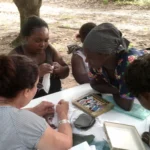
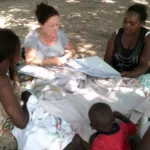
Basic sewing was the first class we could start outdoors under a tree with cloth, a needle and thread whenever we got to Mozambique, with it becoming a permanent class when the construction of a community college is started up. The sewing students will advance to working on sewing machines after the first classes are completed. Carpentry, metalwork, mechanical and more will be introduced as workshops are completed. Community engagement and meetings will inform us about other types of training they would like access to, with enough space for other organisations to work from alongside us.